 Squirtle Squad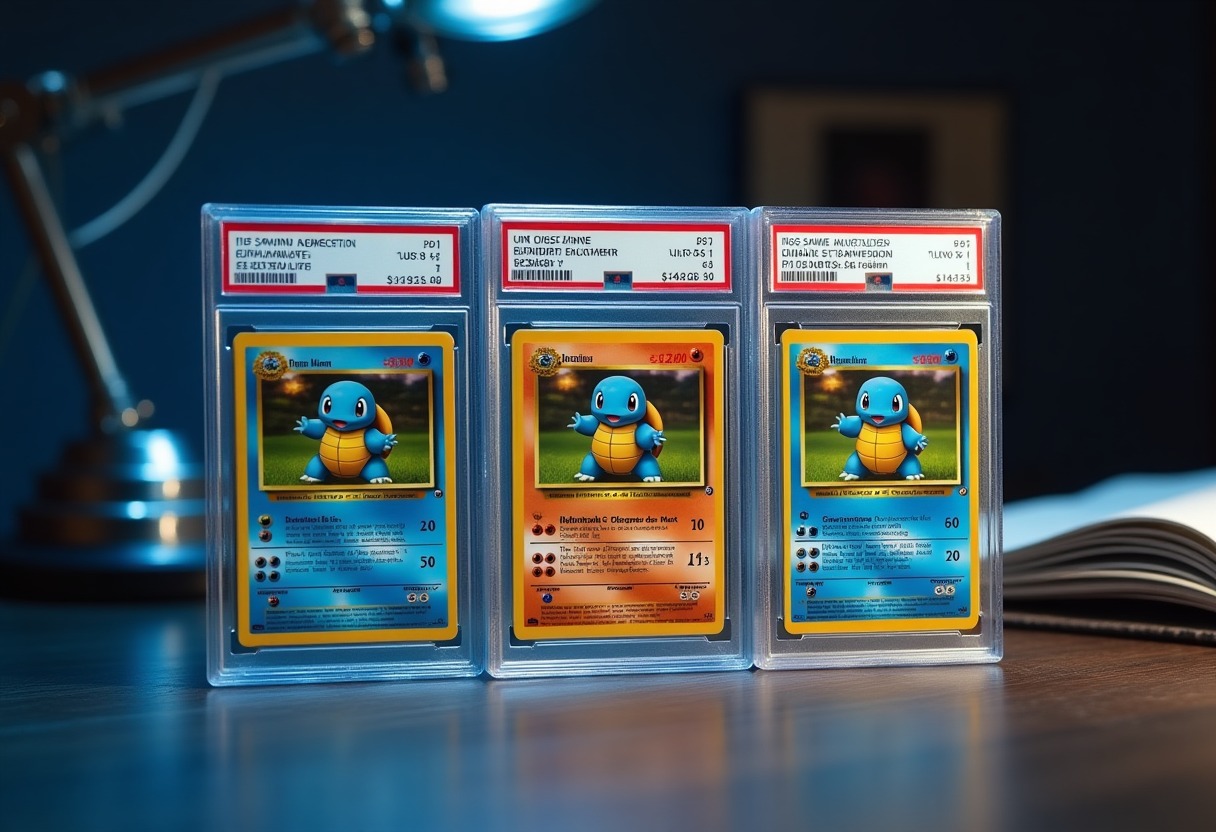
The gap between a PSA 8 and PSA 9 Base Set Shadowless Blastoise can exceed $2,000. For Squirtle line collectors weighing whether to buy already-graded cards or submit raw copies for grading, understanding which grading company holds value best—and which specific cards deserve the slab treatment—separates smart investments from expensive mistakes.
Why Grading Company Choice Actually Matters for Squirtle Line Cards
PSA and CGC dominate the modern graded Pokémon card market, with Beckett (BGS) holding a smaller but established niche. PSA commands the highest premiums for vintage cards—their population reports show over 47,000 graded Base Set Blastoise cards versus CGC's roughly 8,000, creating deeper buyer confidence and resale liquidity. [PSA's market dominance](https://www.psacard.com/) translates to 15-30% higher realized prices for identical vintage Squirtle line cards in comparable grades.
CGC gained serious ground since 2020 by offering subgrades (similar to BGS) at lower submission costs, appealing to modern card collectors. Their crystal-clear cases photograph better than PSA's older holder design, which matters for social media-driven sales. For cards printed after 2016—including alternate art Blastoise from recent sets—CGC 9.5s often match or exceed PSA 10 prices because subgrades provide granular quality verification.
The [Most Valuable Blastoise Cards All Time](/blog/most-valuable-blastoise-cards-all-time) typically see 3-5x multipliers when graded PSA 10 compared to raw Near Mint copies. That multiplier shrinks dramatically at PSA 8 or below for commons and uncommons, where grading fees outweigh value gains.
Investment-Worthy Squirtle Cards That Deserve Professional Grading
Not every Squirtle card benefits from the $20-150 grading investment. Focus on cards where the slab genuinely protects value or creates market separation:
Base Set through Neo Series holos and 1st Editions: Any Squirtle, Wartortle, or Blastoise from 1999-2000 sets with clean centering and sharp corners qualifies. Base Set 1st Edition Blastoise in PSA 9 sells for $1,500-2,500, while raw copies struggle to break $800 due to authentication concerns. Shadowless variants command even steeper premiums—a PSA 10 Shadowless Blastoise sold for $32,400 in 2023.
Aquapolis and Skyridge holos: These e-Reader era cards have low print runs and condition-sensitive holo patterns that grade poorly. A CGC 9 Blastoise from Aquapolis (the one with Crystal type mechanics) regularly hits $400-600, while PSA 8 copies languish at $150. The scarcity multiplier makes professional authentication critical.
Modern alternate arts and illustration rares: The Blastoise alternate art from Pokémon GO set and the Blastoise VMAX alternate art from Vivid Voltage both exceed $100 raw. CGC works better here—subgrades prove the card's pristine state to buyers who otherwise suspect trimming or corner wear. A CGC 9.5 with four 9.5 subgrades sells 40% higher than a straight PSA 9.
Promo cards with distribution concerns: The Wartortle staff promo (Pokémon Day 2000) and Squirtle Squad Leader cards with sunglasses see frequent counterfeits. PSA verification alone adds $50-100 in buyer confidence premium. Check our [Squirtle Squad Leader Card Guide](/blog/squirtle-squad-leader-card-guide-every-squirtle-with-sunglasses-card-ever-released) for specific printings worth authenticating.
Skip grading: unlimited Base Set commons below holo rarity, damaged vintage cards that won't grade above PSA 5, and modern bulk rares from recent sets unless they're alternate arts or have collectible appeal beyond playability.
PSA vs CGC: Head-to-Head Value Comparison
| Grading Factor | PSA Advantage | CGC Advantage |
|---|---|---|
| Vintage cards (pre-2003) | 20-30% higher resale prices for PSA 9-10; deeper buyer pool; established population reports create scarcity verification | Lower submission costs ($25 vs $50+ for standard service); faster turnaround at bulk tiers |
| Modern cards (2016+) | Better recognized at major auctions; stronger brand trust among high-end collectors ($1,000+ cards) | Subgrades provide quality proof; clearer cases for photography; competitive pricing at 9.5 grade level |
| Centering tolerance | More forgiving on vintage cards—PSA 10s can have 60/40 centering in some cases | Stricter centering requirements mean CGC 10s truly represent perfect cards; 9.5s match PSA 10 quality |
| Market liquidity | 3-5x more PSA listings on eBay/TCGPlayer for vintage Squirtle cards; faster sales | Growing acceptance; preferred by some Japanese card collectors; stronger in UK/EU markets |
For investment purposes, submit vintage Squirtle line cards to PSA if you're targeting grades 9-10 and have patience for 60-90 day turnarounds. Use CGC for modern alternate arts, cards where you want subgrade documentation, or when you're submitting 50+ cards for bulk pricing ($14-17 per card).
The [Complete Blastoise Card Collection Guide](/blog/complete-blastoise-card-collection-guide) covers which specific printings have sufficient value to justify either company's grading fees.
Cards Worth Submitting Right Now in 2026
Five Squirtle line cards currently show the strongest grading ROI based on recent sales data:
1. Base Set Unlimited Blastoise (holo): Raw Near Mint copies sell for $150-250. PSA 9 slabs consistently hit $450-600, and PSA 10s reach $2,000+. The grade boundary between 8 and 9 represents a 150% value jump—worth the submission risk if your card has strong centering and minimal holo scratching.
2. Boundaries Crossed Blastoise (Secret Rare #142): The gold card version with 100% gold holo coverage grades notoriously tough due to surface wear visibility. CGC 9.5s sell for $350-450 versus $120-150 raw. This card specifically benefits from CGC's subgrade system proving surface integrity.
3. XY Evolutions Blastoise (holo rare): This 20th-anniversary reprint of Base Set's Blastoise art has become the affordable entry point for new collectors. PSA 10s sell for $80-120 versus $15-20 raw. With modern print quality, 10s are achievable—making this a volume play for grading services.
4. Team Rocket Dark Blastoise (1st Edition): Undervalued compared to Base Set, this villain-themed variant in PSA 9 sells for $300-400. Recent auction results show 45% year-over-year appreciation. The card's dark holo pattern hides minor scratches that would destroy Base Set grades, giving you better odds at high marks.
5. Any Squirtle Squad sunglasses variant: These novelty cards from various promo sets maintain cult followership. Authentication matters more than grade—even PSA 6s sell for premiums over raw copies because counterfeits plague the market. See our guide to [Wartortle Cards Worth Collecting](/blog/wartortle-cards-worth-collecting) for middle-evolution targets.
Before submitting anything, buy proper protection supplies: [→ Shop card saver holders on Amazon](https://www.amazon.com/s?k=card+saver+holders&tag=squirtlesquad0d-20) for submissions and [→ Shop penny sleeves on Amazon](https://www.amazon.com/s?k=pokemon+card+sleeves+penny&tag=squirtlesquad0d-20) for initial protection. Cards damaged during shipping get "minimum grade" or "N/A" results—you'll pay grading fees for an unusable slab.
The Grade Gaps That Actually Drive Value
Understanding where premiums spike helps you decide whether to crack a lower-grade slab and resubmit:
PSA 7 to PSA 8: 30-50% value increase for vintage holos. This jump represents crossing from "visible wear" to "light play" condition—the minimum grade most serious collectors accept for display copies.
PSA 8 to PSA 9: 150-200% increase for key vintage cards like Base Set 1st Edition Blastoise or Neo Genesis holos. This is the single most valuable grade boundary. Cards that might grade 8.5 (not a PSA option) often get pushed to 8, creating opportunity when you crack and resubmit strong 8s.
PSA 9 to PSA 10: 200-400% increase for ultra-premium cards (Base Set 1st Edition, Skyridge, Gold Stars if they ever print them). Diminishing returns set in here for cards below $500 in PSA 9 condition—the population difference between 9 and 10 can be 20:1, making 10s exponentially rare but not exponentially desirable for mid-tier cards.
CGC 9 to CGC 9.5: 40-70% increase for modern alternate arts and illustration rares. CGC's half-point scale creates this premium tier that PSA lacks. A CGC 9.5 with four 9.5 subgrades effectively equals a PSA 10 in buyer perception for cards printed after 2020.
Any grade to PSA/CGC 10: For modern cards (2020+) with print runs exceeding 50,000, the PSA 10 premium drops to 20-30% over 9 because population numbers dilute scarcity. This is where raw mint copies often deliver better ROI than paying grading fees.
Check [Rarest Squirtle Pokemon Cards](/blog/rarest-squirtle-pokemon-cards) for specific population reports that inform which grade tiers matter most for your target cards.
Protecting Your Investment After the Slab Arrives
Graded slabs aren't indestructible. PSA cases crack from 4-foot drops onto hard surfaces; CGC's edge seals can separate in extreme humidity. Store slabs vertically in [→ Shop card storage boxes on Amazon](https://www.amazon.com/s?k=graded+card+storage+box&tag=squirtlesquad0d-20) with foam separators, never stacked horizontally where weight pressure distorts older PSA holders.
Keep slabs out of direct sunlight—UV exposure fades holo patterns even through the protective case, gradually downgrading the card's visual quality despite the permanent grade. Temperature swings above 80°F or below 50°F can cause condensation inside slabs, creating moisture spots that lower resale value even though the technical grade remains unchanged.
Insurance matters once your collection exceeds $2,000 in graded value. Photograph certification numbers on case labels and maintain a spreadsheet linking cert numbers to purchase prices. PSA and CGC both maintain online verification databases—buyers check these before paying premium prices, so never attempt to alter cert numbers or swap labels between cases.
For display purposes, [→ Shop ultra pro one touch holders on Amazon](https://www.amazon.com/s?k=ultra+pro+one+touch+holders&tag=squirtlesquad0d-20) work well for raw cards you're considering for future submission. These rigid holders prevent edge wear and corner damage during the evaluation period before you commit to grading costs.
When Cracking and Regrading Makes Financial Sense
PSA 8 Base Set Blastoise cards with exceptional centering and holo quality sometimes deserve a crack-and-resubmit gamble. If the card's 8 grade came from minor edge whitening but centering measures 55/45 or better, resubmission odds favor PSA 9—worth the $75 risk (grading fee plus card value loss if it drops to 7) when the 9 sells for $450 versus your $200 in the 8.
Never crack CGC cases for PSA resubmission unless you're working with pre-2000 cards worth over $500 in current grade. The market's growing CGC acceptance means you're gambling $150+ in fees and reslab costs against a PSA premium that's shrinking 5-8% annually for modern cards.
Bulk submission services (20+ cards) bring per-card costs down to $17-25 depending on declared value. If you're sitting on 30+ raw Near Mint Squirtle line cards from your childhood collection, bulk submission to PSA or CGC makes sense—but send only cards you've prescreened with proper lighting and magnification. Services like [→ Shop PSA submission kits on Amazon](https://www.amazon.com/s?k=psa+card+submission+kit&tag=squirtlesquad0d-20) include the forms, sleeves, and guidance needed for your first submission.
For additional grading strategy across the TCG landscape, see the comprehensive guide at [The TCG Slayer](https://thetcgslayer.com/blog/grading-pokemon-cards-psa-bgs-cgc) covering all major grading companies and service levels.
FAQ
Should I grade unlimited Base Set Squirtle commons?
No. Commons from unlimited print runs rarely justify grading costs unless they're pristine 10 candidates, and even PSA 10 Base Set Squirtle commons sell for only $40-60—barely covering submission fees and shipping. Save grading budget for holos, 1st editions, or cards worth $50+ in raw condition.
Does CGC or PSA grade Japanese cards better for Squirtle line investments?
CGC handles Japanese card submissions with faster turnaround and provides Japanese-language cert labels, but PSA still commands 15-20% higher prices for Japanese vintage cards at auction. If you're holding Japanese Squirtle/Wartortle/Blastoise cards for 5+ years, choose PSA for maximum resale value despite slower service.
At what card value does grading stop making sense?
Below $30 raw value, grading fees plus shipping ($25-40 total) erase profit margins unless you're confident in PSA 10. Above $500, authentication and grade protection always justify costs—counterfeits and condition disputes plague high-value transactions where a slab eliminates buyer hesitation.
Can I resubmit a PSA 9 hoping for a 10 without cracking the case?
No. PSA's reholder service replaces damaged cases but won't regrade the card. You must crack the existing case, accept the risk of damage or grade drop, and pay new submission fees. The 9-to-10 bump has 15-25% success rates for vintage cards according to collector community data, making it a true gamble.
Which Wartortle cards are undervalued in graded form right now?
Team Rocket Dark Wartortle (1st Edition) in PSA 9 sells for $45-65 but appreciates 30% annually. Expedition Wartortle (reverse holo) grades tough due to surface texture—PSA 9s sell for $80-110 versus $15-20 raw. Both cards fly under radar compared to Blastoise investments but show stronger percentage gains.
The Bottom Line on Squirtle Line Graded Card Strategy
PSA dominates vintage Squirtle, Wartortle, and Blastoise card values while CGC captures modern alternate art premiums through subgrade verification—choose your grading company based on print era and target grade, not blanket loyalty.
Some links on this page are affiliate links. We may earn a small commission if you purchase through them, at no extra cost to you.